The ScreenJSON toolchain.
Nine entry points, all built around the same open schema. Pick the one that fits your stage: open-source conversion and database import, licensable infrastructure, an embeddable UI package, or native viewers on desktop and mobile.
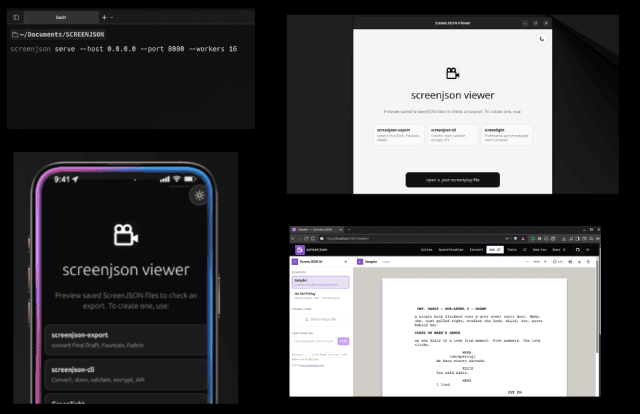
screenjson-export
Go · Docker
A free, open-source CLI that converts writer-format screenplays into ScreenJSON.
screenjson-cli
Go · Docker
The full command-line tool for convert, export, validate, encrypt, and REST API workflows.
screenjson-db-importer
Go · Docker
A free, open-source CLI that loads folders of ScreenJSON into a database or vector store.
screenjson-server
Go · Svelte · Docker
The API and MCP platform for collaborative agent editing: whole libraries of screenplay JSON in your NoSQL database and S3, edited by many agents at once.
screenjson-ui
TypeScript · Svelte
An embeddable JavaScript package for rendering ScreenJSON in the browser.
Desktop Viewer
Desktop
Windows, macOS, and Linux AppImage builds.
iOS Viewer
iOS
Native iPhone and iPad reader.
Android Viewer
Android
Native Android screenplay reader.
greenlight
Go · Svelte · Docker
A batch microservice with a job queue. Ingest from S3, run pipelines of conversion tasks, deliver at scale.
HOW THEY COMPOSE
A stack, not a pile.
screenjson-export is the reference implementation. It reads FDX, writes ScreenJSON, and nothing else. MIT-licensed. Use it to learn the format, to integrate with a simple pipeline, or as an audited target to compare your own converter against.
screenjson-cli is the full tool: every format in, every format out, plus validation, encryption, storage drivers, and a REST API mode. Licensable for commercial use.
screenjson-db-importer is the free way to store what you've converted. It validates every document against the schema and writes it to PostgreSQL, MongoDB, Elasticsearch, Chroma, Weaviate, or Pinecone, whole or split into scenes and lines. Open source.
screenjson-server turns that database into a platform for mass editing. A REST API and an MCP server put every scene and line within reach of people and AI agents; many of them edit at once without overwriting each other; passes share a library-wide job across hundreds of workers; scripts mirror to S3 as they change. Licensable for commercial use.
screenjson-ui is the browser-side half of the stack. Embed it in any web app and it renders a ScreenJSON document as a studio-quality screenplay.
Greenlight puts all of the above behind a job queue and an admin UI. For when a single invocation isn't enough and you need to process 10,000 screenplays without thinking about it.